A tattoo can be fully removed, but it's never guaranteed.
Research shows only 38–47% of people achieve what clinics call "complete removal" (often with different meanings), and the likelihood of making your skin look as if the tattoo was never there depends on several factors.
The strongest factor is ink density, followed by your tattoo colors, immune system health, skin type, the laser operator's skill, and the laser used.
Let's look at each factor in detail, but first we must understand what "full removal" actually means for laser clinics, because it's not what most people think.
What "complete removal" actually means (and doesn't)
There is no standardized definition of "complete tattoo removal."
Every laser technician will eyeball the result of a treatment and assign an arbitrary success score. For example, when researchers from the Journal of the American Academy of Dermatology conducted a systematic review of 36 studies covering 1,560 patients, they used >75% clearance as their primary outcome, not 100%.
Read that again: a tattoo that's 76% gone and one that's 100% gone are both considered "excellent" results.
In the largest prospective study on this question (Bencini et al., published in JAMA Dermatology in 2012 with 352 patients), "successful removal" meant that the technician considered the tattoo no longer visible as a tattoo, and the skin had no lasting damage (temporary lightening or darkening of the area remained acceptable). The study found that only 47.2% achieved successful removal after 10 sessions, rising to 74.8% after 15 sessions.
According to our data, for most clinics "complete" means 95% or more clearance at conversational distance. A casual observer wouldn't notice a tattoo was ever there. True 100% clearance (zero residual pigment, no change in skin texture) is rare enough that no peer-reviewed study or clinic guarantees it.
From a legal standpoint, the clinic sells you only the process of trying to remove the ink, not the final result. This distinction is important but often buried in the consent form you sign before starting treatment.
1. Ink density
Ink density (how much ink is in the skin) is the strongest independent predictor of removal difficulty, according to the Smarrito-Pineau study of 116 patients in 2025. The volume of pigment, how saturated it is, and how many layers it spans determines more than any other factor how many sessions you'll need and whether complete clearance is realistically possible.
This also explains why cover-ups (when a new tattoo has been placed over an older one) take longer to remove. Cover-up designs typically contain roughly twice the ink volume of a regular tattoo, since the new piece needs to be larger and more saturated to conceal the original. The laser will have to first clear the new tattoo, then remove the old one underneath.
 |
 |
|---|
Removing a coverup tattoo means:
- More sessions needed
- More cumulative skin stress
- Higher cost
- Higher chances that you give up before the end of the treatment
If you want to remove a covered-up tattoo, be skeptical of any session estimate that doesn't explicitly account for the multiple layers.
Ink depth
The deeper the ink goes in your skin, the harder it'll be for the laser to reach the pigment with enough energy to shatter it, and for your lymphatic system to flush it out.
Amateur or homemade tattoos typically have shallower ink and respond faster to laser removal than professional tattoos, though results can be less predictable. Professional tattoos are the opposite: deeper and more uniform ink placement that takes more sessions but produces more predictable results.
One thing to note: ink depth is a factor that can't be measured. It reveals itself only during treatment, when ink that looks light on the surface proves stubborn session after session. So don't be surprised if a heavily saturated stick-and-poke proves harder to remove than a lightly shaded machine-made piece.
Scarring
Tattoos that go too deep often cause scarring, which acts as a physical barrier that locks ink particles in place. In this case, the laser may never be able to reach the ink or break it down enough for your immune system to access it. And even if it manages to break through, since scar tissue has lower blood and lymphatic flow than healthy skin, your vascular system may not be able to flush the shattered ink particles away.
That said, complete removal is statistically possible on most tattoos unless the scar is very thick, but it will require more sessions and a skilled technician.
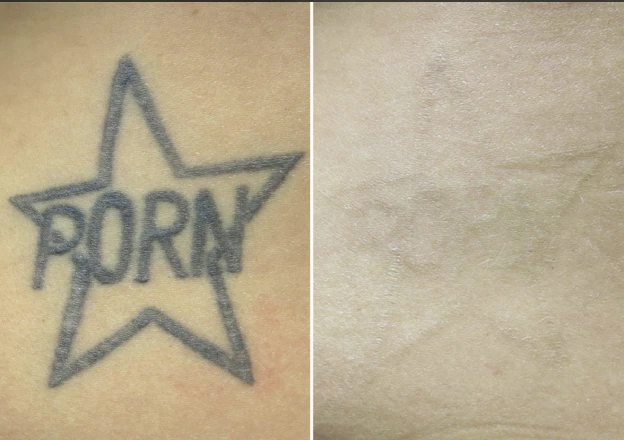
Complete removal on a heavily scarred tattoo by @gotattooremoval
2. Ink colors
Different laser wavelengths target different colors. If the laser cannot "see" the color, it can't break it down.
- Black and dark blue inks are the easiest, since they absorb the energy of all laser wavelengths
- Red ink is statistically possible, though some red inks contain iron oxide, which brings risks of paradoxical darkening
- Green and blue are quite stubborn, reducing the likelihood of complete removal by roughly 80% after 10 sessions, according to Bencini et al.
- No laser can effectively and consistently remove yellow, orange, and neon colors, since they often reflect laser energy
- White ink is not just the hardest to remove, it can actually make things worse. The FDA warns that white ink can oxidize and turn black after laser treatment, making the tattoo no longer treatable. The worst case scenario here is not incomplete removal, but a tattoo that ends up darker than when you started. Flesh-colored inks and permanent makeup have the same problem.
Ink composition
Another factor that many clinics mention only when the treatment is not working: nobody knows what's in your ink.
If you don't know what the ink is made of, you can't tell how it will respond to a laser. Two green inks from different suppliers, treated with the same laser and settings, will not necessarily fade the same way.
A study by Kelli Moseman, a chemistry researcher at Binghamton University in New York, found that 90% of the inks tested contained undisclosed substances that varied significantly from their labeled ingredients. A 2021 EU study confirmed major issues with mislabeling and unlisted additives in a similar proportion (around 90% of inks analyzed).
The 2024 Binghamton University study of US inks found that 45 out of 54 inks contained unlisted additives and/or pigments, making it basically impossible to standardize success rates.
In response to this, the EU restricted over 4,000 chemical substances in tattoo inks in 2022, whereas the FDA has no list of restricted substances for tattoo inks in the United States.
This is one reason why a patch test is useful before jumping into a full treatment plan.
3. Body location
The laser doesn't remove your tattoo. Your lymphatic system does.
Tattoo permanence depends on a macrophage capture-release-recapture cycle. Dermal macrophages swallow ink particles but can't break them down. When those macrophages eventually die, they release the ink, and new macrophages immediately swallow it again. This cycle repeats indefinitely. After each laser session, the same cycle works against you: fragmented particles get recaptured by fresh macrophages before your lymphatic system can flush them out. That recapture cycle is also why spacing between sessions matters more than total session count. Each visit needs enough time to finish clearing before the next one starts. Here's how the laser mechanics and the macrophage cycle work together to determine your timeline.
Body areas with high blood flow and closest to lymph nodes, such as head, neck, and upper torso, have the highest chance of full removal. The opposite is true for feet, ankles, and hand tattoos, because circulation is weakest in the extremities, making it much harder for the body to flush out every microscopic particle. The common result of this is "ghost" ink.
This also explains why waiting 8 weeks or longer between sessions statistically gives better removal results. You need to give your body enough time to clear the ink fragments before getting lasered again.
4. Smoking
Smoking is the single biggest factor under your control, because it weakens your immune system. Like we said before, your immune system is what does the work of removing the ink shattered by the laser.
In the Bencini study, smokers had a 69.7% lower success rate after 10 sessions compared to non-smokers. This happens because nicotine constricts blood vessels, reduces oxygen transport, and suppresses the inflammatory response that drives ink clearance.
Quitting smoking is the highest-impact decision you can make to increase your chances of removing an unwanted tattoo.
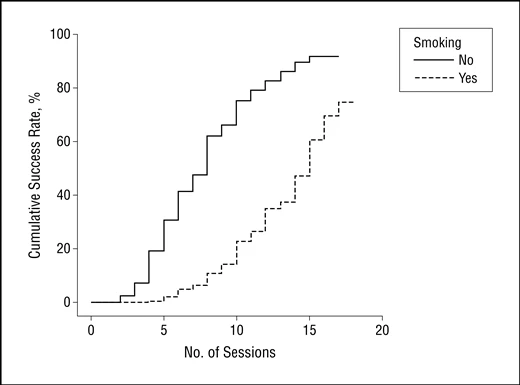 The cumulative rate of smokers vs non-smokers reaching complete removal
5. Skin type
Lighter skin types (I–II on the Fitzpatrick Scale) usually need fewer sessions, while darker skins (IV–VI) can be fully removed but require more sessions, and there's a higher risk of complications like hyperpigmentation (darkening) or hypopigmentation (lightening), that could force you to stop the removal treatment.
The problem with darker skins is that melanin competes with ink as a target for laser energy. Darker skins contain more melanin, so they absorb more energy, forcing your laser practitioner to use lower energy settings in order to avoid permanent skin lightening (hypopigmentation). These lower energy settings may not be enough to break the last particles of ink.
One thing that's rarely mentioned is that the Fitzpatrick scale isn't fixed. You may be type III that becomes a type IV after summer sun exposure, and this affects your removal treatment. The British Medical Laser Association guidelines explicitly state that treatment should be postponed if skin tone has changed due to sun exposure.
6. The laser technician
The laser used matters, but who uses it matters more.
A 2012 study of 352 patients found that insufficient energy settings or poor treatment protocols was one of the leading causes of incomplete removal. A poorly calibrated laser can fail to fragment ink as much as needed, scatter it deeper into the dermis, or even cause scarring that permanently traps residual pigment.
When evaluating a technician, ask to see before and after photos of treatments performed on tattoos and skin just like yours. Our gallery has plenty of before and after photos of tattoo removal procedures that you can filter by your skin type.
Browse the gallery →7. Laser technology
There's a lot of talk about picosecond vs Q-switched, and it's mostly marketing without solid evidence. The mixed results from recent studies are proof of that:
- The largest RCT (Lorgeou et al., 2018, 49 patients) found picosecond lasers achieved 75% or more clearance in 33% of treated halves versus 14% for nanosecond lasers
- Another RCT (Pinto et al., 2017, 21 patients) found no significant difference after two sessions
- A 2025 meta-analysis of 21 studies covering 971 patients concluded picosecond showed only borderline superiority (P = 0.05) overall, though it was consistently less painful and produced fewer side effects
According to 244,000+ reviews and contributions on our site by laser technicians, PicoSure clearly wins on blue, green, and purple pigments, thanks to its native 755nm wavelength, which is considered the gold standard for these colors. On the other hand, the additional adapter needed to target blacks often lacks the power to penetrate deep enough. We have published several case studies of tattoo removals done with PicoSure that look great after the first 2–3 sessions but where full removal was never reached.
The PicoSure Pro is the fix to PicoSure's power and spot size limitations. Its larger spot sizes (up to 10mm) can reach deeper into black inks without having to shrink the beam, and delivers up to 50% more energy than the original PicoSure.
PicoWay is still considered the best laser to remove black ink, since it natively uses the 1064nm wavelength with a 10mm spot size that penetrates deeper with high energy. The other two native wavelengths (532nm and 785nm) work well on reds, blues, and greens without relying on smaller, underpowered adapters. See how PicoWay works across all four wavelengths for a full breakdown.
Even the best laser machine is useless without proper settings and protocols. The person using the laser is even more important than the laser itself. Look for a tattoo removal technician who can show you a portfolio of results achieved with the same laser they will use on you.
Sources
- Bencini et al., JAMA Dermatology, 2012 — prospective study, 352 patients, success rates by session count and smoking status
- Leger et al., Journal of the American Academy of Dermatology — systematic review of 36 studies, 1,560 patients
- Lorgeou et al., PubMed PMID 28758261, 2018 — RCT, picosecond vs nanosecond, 49 patients
- Pinto et al., British Journal of Dermatology, 2017, PubMed PMID 27518129
- Comparative appraisal of picosecond versus nanosecond lasers, Lasers in Medical Science, 2025
- Smarrito-Pineau et al., 2025 — 116 patients, ink density as independent predictor
- Gurnani & Brauer, PMC10082917 — Nd:YAG Laser Tattoo Removal in Skin Phototypes IV–VI, 2023
- StatPearls, Laser Tattoo Removal, NCBI Bookshelf NBK442007
- British Medical Laser Association Treatment Guidelines, 2019
- Kelli Moseman / Binghamton University, 2024 — US tattoo ink composition study (45/54 inks with unlisted additives)
- European Chemicals Agency, REACH Tattoo Ink Restrictions, 2022
- FDA, Tattoo Removal: Options and Results
- FDA, Tattoos and Permanent Makeup Fact Sheet
- Baranska et al., Journal of Experimental Medicine, 2018 — macrophage capture-release-recapture cycle
- Kirby & Desai, Journal of Clinical and Aesthetic Dermatology, 2009