Small tattoo removal costs $150–$300 per session at most US clinics, with total removal running $1,200–$3,600 over 8–12 sessions. Coin-size tattoos under 1 square inch start as low as $100/session.
Those numbers assume favorable conditions: black ink, a well-circulated body location, and a straightforward professional tattoo. A small finger tattoo, a multi-color symbol, or any small piece that is heavily saturated can cost more in total sessions than a larger tattoo in a favorable location. Understanding exactly why, and how clinics calculate your tier, is the difference between budgeting accurately and getting a surprise quote at your consultation.
What "small" actually means in a clinic's pricing system
Most US clinics price tattoo removal by size tier, not a flat per-session rate. The tier your tattoo falls into sets your per-session price, so the first thing you need is a precise size.
The industry-standard breakdown by surface area:
| Tier | Surface area | Typical examples |
|---|---|---|
| Extra Small (XS) | Under 1 square inch | Small initials, single symbol, minimalist line, dot accent |
| Small | 1–4 square inches | Wrist name, small script, palm-size symbol |
| Medium | 4–16 square inches | Hand-size design, standard phone-size piece |
| Large | 16–36 square inches | Half-sleeve segment, full shoulder cap |
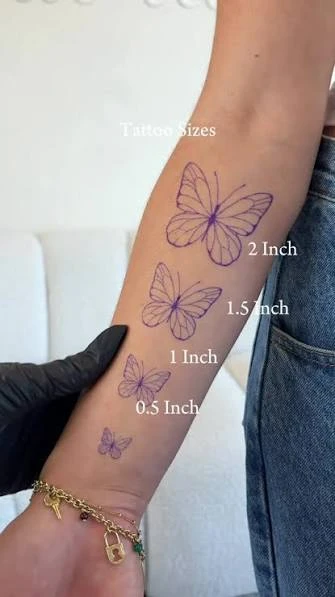
Size reference: 0.5 inch fits under 1 square inch (XS tier); 2 inch butterflies are roughly 4 square inches depending on width (top of Small tier).
How to measure your tattoo accurately
Measure the bounding box of your design (the smallest rectangle that contains the entire tattoo), not just the inked portions. Height (inches) × width (inches) = surface area in square inches.
This catches most people out. A script tattoo reading a name in 1-inch letters that runs 4 inches across is 4 square inches, sitting right at the top of the Small tier. A small geometric triangle with negative space is measured corner to corner, not edge of ink to edge of ink. Clinics measure the total footprint of the design, because that is the area the laser must cover.
Some clinics measure ink area only (skipping unpainted gaps in the design). Ask at your consultation which method they use. It can shift you between pricing tiers on irregular designs.
Why "credit-card size" is misleading
You'll see "credit-card size" used as a benchmark throughout the tattoo removal industry. A credit card is 3.37 × 2.13 inches, which is 7.2 square inches. That actually falls in the Medium tier by surface area. When clinics say "credit-card size" they typically mean a tattoo that could fit within the card's footprint while filling only part of it: roughly 2–4 square inches. If your tattoo truly fills a credit card frame, get a size-specific quote rather than assuming Small pricing.
When a "small" tattoo isn't small
Long, narrow tattoos are the most common source of pricing surprises. A script tattoo that reads two words in thin lettering across the inner forearm might look small but span 6 inches at 0.75 inches tall, which is 4.5 square inches and lands in Medium at most clinics. The same applies to band tattoos around the wrist: narrow but continuous circumference adds up fast. Any time a tattoo is long in one dimension, measure it before assuming the tier.
Per-session cost and total removal cost
Based on verified pricing from 3,000+ US clinics:
| Size tier | Surface area | Per session | Total (8–12 sessions) |
|---|---|---|---|
| XS | Under 1 sq in | $100–$200 | $800–$2,400 |
| Small | 1–4 sq in | $150–$300 | $1,200–$3,600 |
| Medium | 4–16 sq in | $300–$450 | $2,400–$5,400 |
The total range shown above assumes 8–12 sessions. That is the standard for most professional tattoos. Sessions are spaced 8–10 weeks apart to allow the skin to heal and the lymphatic system to clear fragmented ink between treatments. At that pace, a 10-session course runs roughly 20–24 months from first session to final clearance. What changes the session count (and therefore your total cost) is covered in detail below.
What the advertised "$100/session" price actually means
Almost every clinic that advertises a low per-session rate is quoting their XS tier. At the same clinic, a credit-card-size tattoo (Small tier) may be $200/session, and a hand-size piece may be $350. The low advertised number is accurate, but only for a tiny piece. It is not your price unless your tattoo is under 1 square inch.
When you call for a quote, say the size explicitly: "I have a tattoo on my wrist that is approximately 2 inches wide by 1.5 inches tall. What would that be priced per session?" A clinic that gives you a firm answer without seeing the tattoo is guessing. A good clinic will say to come in for a free consultation and give you a written quote after seeing it.
What drives the spread within a tier
Two people with identically-sized small tattoos at the same clinic can pay different amounts based on:
- Ink colors. Multi-color tattoos require multiple wavelengths. Some clinics charge a flat rate regardless of color; others charge more for color work. Ask specifically.
- Body location. Some clinics charge a premium for high-difficulty areas (fingers, face, lips). Others do not. This is not standardized.
- Operator experience. A clinic staffed by physicians or experienced technicians typically charges more than one run by newly certified staff.
- Equipment. Clinics running older Q-switch lasers may charge less per session; those with newer pico-second systems with multiple wavelength capability tend to charge more.
How geography moves your price
Where you live affects your per-session cost substantially. From our database of verified US clinic pricing:
| State | Avg min/session | Avg max/session |
|---|---|---|
| Missouri | $263 | $687 |
| New Jersey | $211 | $485 |
| Pennsylvania | $210 | $576 |
| California | $196 | $494 |
| New York | $152 | $482 |
| Washington | $133 | $399 |
| Utah | $102 | $325 |
| Rhode Island | $78 | $342 |
| District of Columbia | $63 | $500 |
The national median starting price across all states is $164/session. The median upper price is $484/session. For a 10-session Small-tier treatment at median rates, total cost runs approximately $1,640–$4,840 depending on which end of local pricing you're on.
Real estate and labor costs are the primary driver of geographic spread. A removal clinic in a Manhattan high-rent building passes those costs on in pricing. The same procedure in a mid-size Midwest city costs less, not because the laser is different but because overhead is lower.
Is it worth traveling for cheaper removal?
Sometimes. If your closest clinics quote $300/session and you can reach a reputable clinic at $150/session within a 2-hour drive, 10 sessions of $150 savings equals $1,500: real money worth the trips. If traveling requires flights, hotels, and days off work, the math inverts quickly.
What you should never do is travel to a cheaper clinic without verifying the laser, the operator's experience, and before/after results for tattoos similar to yours. A $100/session price at a clinic using an underpowered or poorly maintained laser is not a deal. It is a risk to your skin and your wallet, because poor technique can require corrective sessions or cause complications that cost far more to address.
Why small doesn't always mean cheap
This is where most people get their budget wrong. Per-session cost is set by size. Total cost is set by session count. A small tattoo in a difficult location or with difficult ink can require as many sessions as a medium tattoo in a favorable location, sometimes more.
Finger tattoo removal
Finger tattoos are among the most stubborn tattoos to remove, and experienced practitioners flag them immediately. Two structural reasons drive this:
First, blood flow to the fingers is poor compared to the upper arm or torso. The laser shatters ink into microscopic particles, but it is your lymphatic system that clears those particles from the skin. In areas with poor circulation, that clearance is slower, which means more time is needed between sessions and more sessions are needed overall. A finger tattoo that appears identical to a wrist tattoo in size and ink density can require 12–15 sessions where the wrist piece might clear in 8.
Second, the skin on fingers is thinner than on most body areas. The same energy settings that work cleanly on the upper arm can cause more swelling and longer recovery on a finger. Experienced providers adjust settings downward, which means less ink fragmentation per session, requiring more sessions to compensate.
The practical consequence: a finger tattoo that looks like it should cost $1,000 total often runs $1,500–$3,000+ and takes 2+ years. If you have a finger tattoo, get a session estimate at consultation before accepting the per-session quote as your only number.
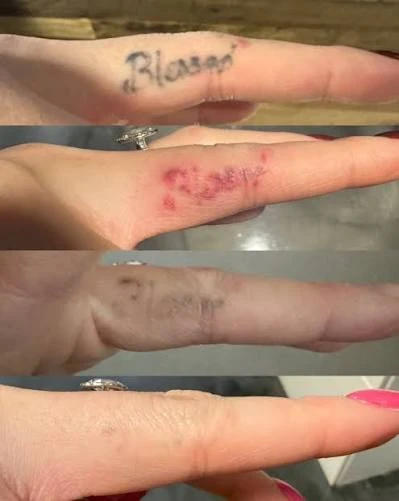
Finger tattoo removal from start to finish. The healing response after each session (panel 2) is more pronounced than on other body areas, and the timeline to full clearance is longer.
Hand and knuckle tattoos
Same circulation problem as fingers, compounded by constant movement and exposure. Knuckle tattoos are particularly difficult: the skin over the knuckle stretches and compresses constantly, which disrupts healing between sessions. Expect extended timelines.
Wrist tattoos
Wrists have better circulation than fingers but worse than the upper arm. A small wrist name in black ink typically clears in 8–12 sessions with no complications. The concern with wrist tattoos is that they are a high-visibility location, and any temporary pigmentation changes (redness, hyperpigmentation) during the removal process are visible to others, which motivates some patients to rush sessions. Don't. The intervals exist for a reason.
Inner lip tattoos
Inner lip tattoos are consistently cited by practitioners as requiring more sessions than expected for their size. The oral environment presents distinct challenges: saliva exposure between sessions, the positioning difficulty of treating curved mucosal tissue, and a healing environment that differs substantially from external skin. Complete clearance is not guaranteed.
If you are considering removing an inner lip tattoo, this should factor into your budget estimate. A 6–10 session expectation at a Small-tier price may extend to 10–15.
Multi-color small tattoos
A session priced for a Small black-ink tattoo assumes one laser wavelength (typically 1064nm) applied in a single pass. A tattoo with black outlines, red fill, and blue shading requires the operator to:
- Treat the black ink at 1064nm
- Recalibrate settings and change handpieces to fire 532nm for the red
- Apply 730nm or 755nm for the blue
Each wavelength change takes clinical time. The laser handpiece changes involve physical equipment adjustments. This additional session time increases the per-session cost at many clinics, and some explicitly charge a multi-color premium for small tattoos that would otherwise price at the low end of the Small tier.
Beyond per-session cost, multi-color tattoos require more total sessions. Black-only tattoos typically clear first. Different colors respond at different rates and may need wavelength-specific sessions late in treatment that extend the overall timeline. A small 3-color tattoo that looks manageable may need 12–14 sessions where a same-size black tattoo needed 8.
Specific color considerations:
- Black: Most responsive. Clears fastest at 1064nm.
- Red: Responds well to 532nm. But 532nm is reactive with melanin in darker skin tones. Practitioners must reduce settings, which slows clearance. Inexperienced operators treating red on darker skin without adjusting for this risk hypopigmentation.
- Blue and green: Require 730nm or 755nm wavelength (PicoWay or PicoSure territory). These colors are among the most stubborn and add sessions.
- Yellow, white, orange: Cannot be reliably cleared by any current laser. If your small tattoo contains yellow or white, complete removal may not be achievable regardless of how many sessions you do. Confirm which specific colors your clinic's laser can target before starting.
Dense and saturated small tattoos
Session count tracks ink volume, not visible surface area. A small geometric mandala packed with solid black ink holds more pigment per square inch than a lightly shaded floral design three times its size. The laser must make more passes over densely packed ink to fragment it to the point where the immune system can clear it.
Old-school prison tattoos, bold geometric designs, blackwork, and solid fill are all examples of small tattoos that can behave like much larger ones in terms of session count. At your consultation, ask specifically how the technician assesses ink density and how that changes their session estimate.
Pre-existing scar tissue in the tattoo
If your tattoo was applied by an inexperienced artist, applied too deep, or healed poorly, there may be scar tissue underneath the ink. The ink conceals it. As sessions progress and ink clears, that scar tissue becomes visible. It can also trap remaining ink particles, making complete clearance impossible without a fractional laser to break up the scar tissue first. This adds cost and time regardless of the tattoo's size.
This is especially relevant for cheap flash tattoos, stick-and-poke work, and tattoos done in unregulated environments.
Cover-up tattoos: the most underestimated cost scenario
A cover-up tattoo at any size carries double the ink of a standard piece, because the new design must be dense enough to conceal the original. A small cover-up (new design is 3 square inches) may have 5–6 square inches of total ink across two layers. It prices and behaves like a Medium tattoo.
Cover-ups consistently require 25–50% more sessions than a standard tattoo of the same visible size. The implications:
- Standard small tattoo: 8–12 sessions → $1,200–$3,600
- Small cover-up: 10–16 sessions → $1,500–$4,800
If your goal is fading for a new cover-up, not full removal, the math changes entirely. Fading to 50–60% clearance typically requires only 2–5 sessions, drastically reducing total cost. At $200/session, 3 fading sessions cost $600 vs $2,000+ for full removal. Discuss this explicitly at consultation: tell the technician your goal is fading for a new tattoo, not complete clearance. This changes both the number of sessions needed and potentially the laser settings used.
Clinic type and what it means for price
Not all tattoo removal clinics are the same. The type of clinic affects both price and quality.
Medical spas and laser studios are the most common. They employ laser technicians certified in tattoo removal. Quality varies enormously at this tier, and per-session prices span a wide range within the national data. Vetting by before/after results is essential.
Dermatology practices that offer tattoo removal charge more because of physician oversight and higher operating costs. For straightforward black ink on fair skin, the price premium may not translate to better results. For complicated cases (darker skin types, difficult colors, suspected scar tissue), physician oversight is worth the added cost.
National chains (Removery, LaserAway, etc.) offer standardized pricing and unlimited treatment packages. Removery's unlimited XS package is flat-priced at $1,499 across US locations. Standardized pricing removes the negotiation but also removes the variability: you know exactly what you're paying regardless of session count.
Independent boutique clinics often have more flexibility on pricing and may offer packages tailored to your specific tattoo. The risk is higher variation in equipment and operator experience.
Package pricing: the math you need before committing
Unlimited-session packages are the most consequential purchase decision in the tattoo removal process. The math is simple; what's not simple is making the right assumptions about session count before you know how your tattoo will actually respond.
When the package saves money
If your tattoo is professional, dense, or on an extremity (finger, ankle, wrist), expect 10–12 sessions at minimum. At $150–$200/session pay-as-you-go, 10–12 sessions cost $1,500–$2,400. Removery's $1,499 unlimited XS package saves you $200–$900 in that scenario, paying for itself after session 8–10.
When the package loses money
If your tattoo is amateur, old and faded, or a simple thin-line design in black ink on an upper arm, it may clear in 4–6 sessions. At $150/session pay-as-you-go, that's $600–$900. The $1,499 package costs you $600–$900 more than you needed to spend.
The questions to ask before buying a package
- Does it expire? A package that expires in 18 months is not useful if your treatment needs 2+ years. Get the expiration terms in writing.
- Is it transferable between locations? If you move cities mid-treatment, can you continue at another clinic in the network?
- What happens if the clinic closes? Independent clinics don't have the same continuity guarantee as national chains.
- Does it cover all sessions, including touch-up sessions after nominal clearance? Some packages exclude final touch-up sessions.
- Is the package priced for my exact size tier, or the tier above? Confirm in writing what surface area the package covers.
The break-even calculation
Divide the package price by your per-session rate to find the break-even session count.
Example: $1,499 package ÷ $200/session = 7.5 sessions. If you need more than 7–8 sessions, the package saves money. If your tattoo will likely clear in 5–6, skip it.
| Sessions needed | @ $150/session | @ $200/session | @ $250/session | Unlimited XS package ($1,499) |
|---|---|---|---|---|
| 4 | $600 | $800 | $1,000 | $1,499 |
| 6 | $900 | $1,200 | $1,500 | $1,499 |
| 8 | $1,200 | $1,600 | $2,000 | $1,499 |
| 10 | $1,500 | $2,000 | $2,500 | $1,499 |
| 12 | $1,800 | $2,400 | $3,000 | $1,499 |
At $150/session, the package breaks even at session 10. At $200, it breaks even at session 8. At $250, session 6. Bold the cells where pay-as-you-go first exceeds the package price to see your personal threshold immediately.
The problem is that no one can tell you with certainty how many sessions your tattoo will need before treatment starts. An experienced technician can give a range estimate at consultation. Use the midpoint of that range in your break-even math, not the optimistic low end.
Ask the clinic to give you a session range estimate in writing before committing to any package. If they refuse or say it's impossible to estimate, that's worth noting. Most experienced practitioners can give a realistic range based on what they see.
What a realistic total budget looks like by tattoo type
| Tattoo type | Size tier | Typical sessions | Estimated total |
|---|---|---|---|
| Small initials or symbol | XS | 6–10 | $600–$2,000 |
| Wrist name (black script) | Small | 8–12 | $1,200–$3,600 |
| Finger tattoo (single element) | XS–Small | 10–15 | $1,000–$4,500 |
| Small multi-color piece (3+ colors) | Small | 10–14 | $1,500–$4,200 |
| Inner lip tattoo | XS | 8–14 | $800–$2,800 |
| Small cover-up | Small | 12–16 | $1,800–$4,800 |
| Small dense blackwork (geometric) | Small | 10–15 | $1,500–$4,500 |
| Old/faded amateur tattoo (small) | XS–Small | 4–7 | $400–$2,100 |
These estimates are based on median US clinic pricing and typical session counts. Individual results vary based on laser used, operator skill, skin type, and lifestyle factors (smoking reduces clearance speed). No table replaces an in-person consultation with your specific tattoo.
How to get an accurate quote (and compare across clinics)
Before the consultation
Photograph your tattoo in natural light against a ruler or measuring tape so you can communicate size precisely. Note the colors present. Know whether it is a cover-up.
Research the clinic's laser before you go. Ask: "What laser do you use, and what wavelengths does it operate at natively?" A clinic that cannot answer this, or answers with "the best one available," should raise your skepticism. PicoWay and Discovery Pico are versatile multi-wavelength options; PicoSure is effective for blue/green/purple but limited on black; older Q-switch nanosecond lasers may cost less per session but often require more sessions overall.
What the laser type actually means for your small tattoo: If your piece is black-only ink on fair skin, most modern lasers perform adequately and the operator's experience matters more than the specific device. The laser selection becomes critically important when you have color tattoos (which wavelengths can the clinic target?), darker skin (1064nm is the safety standard; 532nm on skin types IV–VI carries hypopigmentation risk), or a cover-up (layered ink at different depths benefits from a device with precise fluence control). For a straightforward small black tattoo, don't let laser brand be the deciding factor. Let the before/after portfolio decide.
Consultations should always be free in the US. Any clinic charging a consultation fee is either filtering tire-kickers or adding a revenue stream. Neither reflects well on them. If you're asked to pay to be quoted, go elsewhere.
During the consultation
Ask for all of the following in writing before leaving:
- Per-session price for your specific tattoo at its actual size
- Estimated session range (minimum and maximum)
- Which wavelengths will be used for your ink colors
- Package options and the exact terms (expiration, transferability, what's included)
- Whether the quoted price changes if your tattoo moves to a higher tier mid-treatment (some tattoos photograph small but measure larger in person)
Compare across at least two clinics before committing. The goal is not always the lowest price. It is the best value relative to the operator's experience, the laser's capabilities for your specific tattoo, and the clinic's track record with tattoos similar to yours.
Red flags to watch for
- No before/after portfolio on file, or portfolio that doesn't include tattoos similar to yours
- Session estimates given without looking at the tattoo
- Claims of full removal in fewer than 6 sessions for a professional tattoo
- Per-session price well below $100 for a Small or larger tattoo (often signals underpowered equipment)
- Any pressure to pay for a package upfront before seeing your first session result
Frequently Asked Questions
How much does it cost to remove a small tattoo?
A small tattoo (1–4 square inches) costs $150–$300 per session at most US clinics. Over 8–12 sessions, total removal typically runs $1,200–$3,600. Coin-size tattoos under 1 square inch start at $100–$200/session with totals as low as $800.
How many sessions does a small tattoo take to remove?
Most small professional tattoos require 8–12 sessions. Old, faded, or amateur work may clear in 4–6. Small tattoos on fingers or other extremities often require 12–15 due to poor circulation. Multi-color small tattoos typically add 2–4 sessions compared to same-size black-only work.
Is a small tattoo cheaper to remove than a large one?
Per session, yes. In total, it depends heavily on location and ink. A small finger tattoo in black can cost more overall than a lightly shaded medium tattoo on the upper arm. Size sets your per-session price. Session count (which drives total cost) is determined by location, ink density, colors, and your body's immune response.
Why is finger tattoo removal more expensive than other small tattoos?
Finger tattoos require more sessions due to poor circulation in the extremities. The lymphatic system clears fragmented ink more slowly in the fingers, meaning more sessions are needed and more time must pass between them. A small finger tattoo that prices at the XS or Small tier per session often costs more in total than a larger tattoo in a well-circulated area.
Are unlimited packages worth it for small tattoos?
It depends on your expected session count. Divide the package price by your per-session rate to find the break-even. If the clinic's session estimate puts you above that number, the package saves money. If your tattoo may clear in fewer sessions than the break-even, pay-as-you-go is cheaper. Always ask about expiration dates and what happens if you move or the clinic closes.
Does a small tattoo with color cost more to remove?
Usually yes, in two ways: some clinics charge a higher per-session rate for multi-color work (additional wavelengths mean more clinical time), and multi-color tattoos require more total sessions than same-size black-only tattoos. Yellow, white, and some neon colors cannot be reliably removed by any current laser. Confirm which colors your clinic's equipment can target before starting.
What is the cheapest way to remove a small tattoo?
The cheapest path is paying per session at a clinic with competitive pricing rather than buying an unlimited package, if your tattoo is likely to clear in fewer sessions than the package break-even. Fading for a cover-up (rather than full removal) reduces session count dramatically: 2–5 sessions versus 8–12. Avoid clinics using underpowered equipment to chase a lower per-session price, as more sessions on a weak laser costs more in total.
Does a small tattoo removal hurt?
Yes, though the duration is short for a small tattoo. A coin-size piece may take 30–60 seconds of laser time per session. A credit-card-size tattoo may take 2–4 minutes. The sensation is commonly compared to a rubber band snapping against the skin repeatedly. Most people tolerate small tattoos with no numbing. A Zimmer chiller (cold air device) is standard at most reputable clinics and meaningfully reduces discomfort. See our tattoo removal cost guide for more on what affects session length and comfort.
Sources
- Average_costs.csv — verified pricing from 3,000+ US clinics across 50 states
- tattoo-removal-cost.md — size tier pricing table and Removery package data
- Mike_From_GO_toplevel.csv — session count benchmarks, pricing observations, extremity tattoo difficulty, cover-up session counts
- Mike_From_GO_replies.csv — finger tattoo timelines, cover-up fading estimates, consultation red flags
This article reflects clinical consensus from industry practitioners with 10,000+ treatments and verified pricing from our clinic database.