Laser tattoo removal rarely causes permanent scarring. But it does happen, and understanding why is the most practical thing you can do before starting treatment.
The risk comes from three sources that get lumped together as "scarring": true textural damage, pigmentation changes (lightening or darkening of the skin), and pre-existing scar tissue from the tattoo itself becoming visible as ink clears. Each has different causes, different risk factors, and a different outlook.
Scarring is uncommon, not impossible
With correct protocols, the normal experience after a session is redness and swelling that resolves in 12–72 hours. Properly done laser treatments should rarely cause blistering and should never cause bleeding. When providers stick to appropriate energy settings, appropriate intervals between sessions, and proper aftercare guidance, the large majority of people complete treatment without lasting skin changes.
The risk rises sharply when any of those conditions break down, and especially when they break down together.
What causes tattoo removal scarring
Settings too aggressive
The most common provider-side cause. Higher energy does not mean faster or better results. A provider who pushes energy beyond what the skin can absorb will cause thermal damage, blistering, and eventually textural scarring. Bleeding during treatment is a sign the provider doesn't understand what they're doing, or the laser is out of specification.
The PicoSure spot-size issue. The PicoSure 755nm Alexandrite is a fixed-energy system, meaning operators cannot directly raise its raw power output. To increase fluence (the energy density delivered to the skin, measured in J/cm²), they shrink the handpiece's spot size instead. A smaller beam diameter concentrates the same energy into a smaller area, which spikes fluence at the surface.
The problem is what happens in tissue. A small spot size creates intense lateral light scattering in the dermis, which reduces depth penetration and concentrates heat aggressively and shallowly at the dermal-epidermal junction. This shallow heat load causes epidermal separation, which is the direct mechanism behind the above-average blistering and hypopigmentation rates documented with PicoSure. Modern lasers with independent fluence controls don't behave this way. The beam can maintain depth while energy is adjusted. The PicoSure's spot-size constraint is a design limitation, not a settings error, but it becomes a scarring risk in the hands of providers who don't account for it.
Blistering treated as a good sign
The correct immediate clinical endpoint after a laser pass is frosting: an instant, chalky-white reaction over the treated ink. Frosting is caused by rapid gas bubble (vacuole) formation from the photoacoustic shattering of ink particles. It means the laser reached the pigment at the right depth and energy. It resolves on its own within 15–30 minutes.
Blistering after laser tattoo removal, along with bleeding and weeping skin, are not endpoints. They are adverse effects of thermal overtreatment. Some providers treat visible blistering as proof of an aggressive, effective session. The opposite is true. When blistering occurs, the risk of textural scarring rises, along with the risk of hypopigmentation and keloid formation in predisposed patients.
What you should see in the chair: frosting appears immediately over the tattooed area and fades within minutes. What you should not see: skin bubbling, cracking, or bleeding during or immediately after treatment. If that happens, or if a provider tells you blistering is a sign it's working, take it as a serious red flag.
Sessions too close together
Treating on a 3–4 week cycle does not accelerate removal. It accumulates thermal damage. Clients treated at intervals this short have developed lasting textural damage across large areas. The standard minimum between sessions is 6–8 weeks. Many experienced practitioners prefer 10–12 weeks, particularly toward the end of a removal course, because it gives fading more time to complete and the skin more time to recover.
The R20 technique
R20 refers to multiple laser passes in a single session, with short rests between passes. Some providers use it to compress results into fewer appointments. The problem is thermal accumulation: the skin from the first pass hasn't cooled when the second pass hits. Compounded heat exposure is a direct pathway to blistering and scarring. This technique is not standard care with modern pico-second lasers.
Numbing cream applied incorrectly
Topical anesthetics like 4–5% lidocaine, when heavily occluded under plastic wrap for 60 minutes, can genuinely numb the dermis. The concern is not whether they work; it's what they do to the skin tissue that creates risk.
Heavy topical anesthetic causes localized tissue edema: the skin retains fluid and swells slightly. That excess fluid acts as an optical buffer, artificially masking or delaying the white frosting endpoint during treatment. A provider who doesn't see the expected frosting, because the waterlogged tissue is suppressing the visual signal, may respond by increasing energy or adding another pass. The result is overtreatment that causes the exact blistering and textural damage described above.
This is also why the pain feedback loop matters. Pain during a session signals tissue stress. An over-numbed patient cannot provide that feedback, and a provider relying on the frosting signal doesn't have it either if cream was applied. These aren't reasons to avoid numbing cream entirely, but they're a reason to discuss it with your provider in advance rather than applying it independently.
Picking, soaking, or ignoring aftercare
Picking at blisters, scabs, or frosted skin is the most common patient-side cause of scarring. The treated skin is vulnerable during the healing window. Forcing a blister or pulling off tissue before the underlying skin has rebuilt creates an open wound.
Soaking the area (swimming pools, hot tubs, saunas, baths that submerge the treated area) slows healing and raises infection risk. Direct sun exposure before the skin has recovered can trigger hyperpigmentation that becomes permanent. Most practitioners recommend avoiding direct sun for at least 4–6 weeks after each session, with zinc-based sunscreen for any incidental exposure.
Pre-existing scar tissue from the tattoo
Tattooing is an invasive procedure. Minor scarring from the needle process is common, and in most cases the ink conceals it entirely. As laser treatments clear the pigment, that underlying scar tissue becomes visible for the first time.
This is not damage caused by the laser. But it looks like new scarring, and patients often experience it as a new problem. In denser tattoos, scar tissue can encapsulate ink particles, preventing the laser from reaching the pigment beneath. When this happens, a fractional laser is sometimes used first to break up the scar tissue before tattoo removal sessions resume. This is typically an add-on conversation with your existing provider, adds cost and time, and may require equipment not available at your current clinic.
For a full breakdown of how pre-existing scar tissue affects complete removal, see Can You Completely Remove a Tattoo?
Who is at higher risk
Body location. Extremities (ankles, feet, fingers, wrists) have thinner skin, weaker circulation, and slower healing than the upper arm or torso. The same settings that work cleanly on an upper arm can cause more swelling and textural damage on a wrist or ankle. Experienced providers adjust for this. If yours doesn't mention it when treating an extremity tattoo, ask directly.
Keloid history. People with a history of keloid formation have a higher chance of keloids when blistering occurs. This is specific to those with this predisposition, not a universal risk. Tell every provider about keloid history before treatment starts.
Darker skin types and wavelength choice. For anyone researching laser tattoo removal on dark skin, the choice of wavelength is not a preference, it is a safety decision.
The 532nm wavelength (used for warm-colored inks like red, orange, and brown) has an absorption curve that overlaps almost exactly with human melanin. In darker skin, the epidermal melanin acts as an unintended target, absorbing the laser energy before it reaches the ink. The result is a flash-burn to the melanocytes, the cells that produce skin pigment. Permanent hypopigmentation and severe keloid scarring become a near-structural risk when 532nm is used on skin types IV–VI without extreme caution.
The 1064nm wavelength is the safety standard for darker skin tones. It penetrates deeper into the dermis and bypasses the melanin-heavy surface layer, targeting ink with far lower epidermal absorption. This is why provider experience with darker skin is not just a preference but a clinical differentiator.
Tattoo characteristics. Professional tattoos have deep, dense, uniform ink that requires more energy than the shallow, irregular deposits of amateur work. A provider applying the same settings to both is likely to over-treat the amateur piece. Cover-ups and layered tattoos present additional risk: dense stacked ink can tempt a provider to push settings higher for visible progress. Aggressive settings on a multi-layer tattoo are among the more common causes of blistering.
Unregulated markets. In states or countries with no licensing requirements for laser operators, the scarring risk is meaningfully higher. No oversight means no accountability for training, settings, or standard of care.
What tattoo removal scars look like
The most common laser tattoo removal side effects are temporary pigmentation changes, not permanent scarring. When true scarring does occur, it takes one of these forms:
Hypertrophic scars. Raised, thickened tissue that stays within the boundary of the treated area. More likely after repeated blistering.
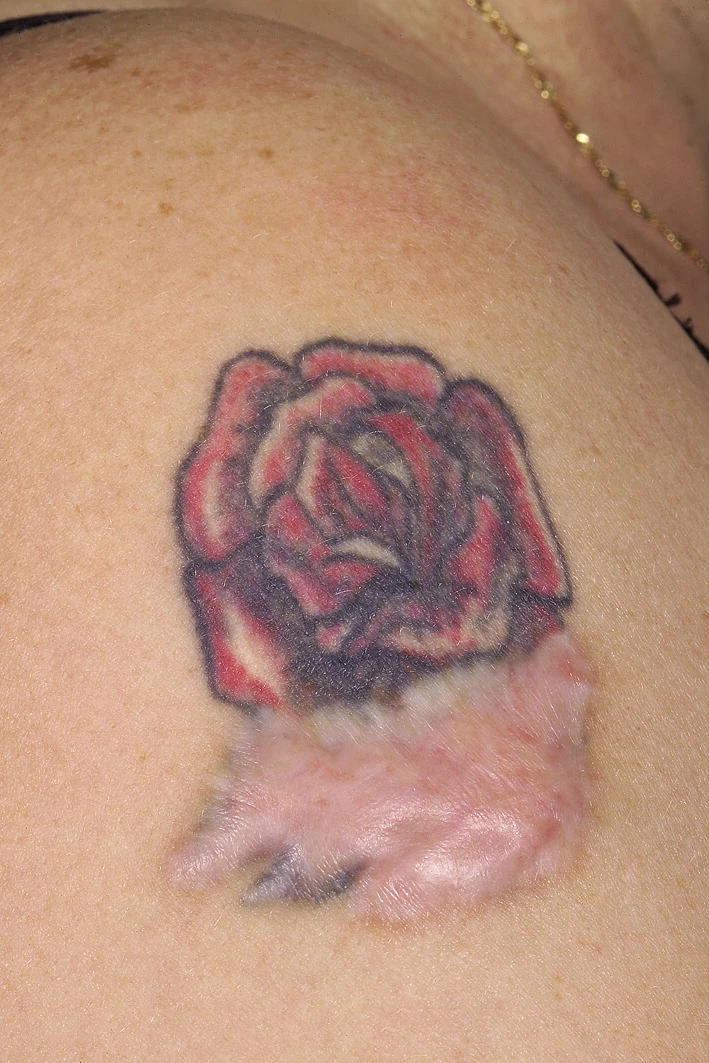
Hypertrophic scarring below a rose tattoo. The raised tissue stays within the original tattoo boundary and is more likely after repeated blistering.
Keloids. Raised scar tissue that extends beyond the treatment boundary. Specific to keloid-prone individuals.
Atrophic changes. A pitted or depressed appearance from collagen loss in the dermis, caused by infection, repeated overtreatment, or both.
Hypopigmentation. Patches of skin lighter than the surrounding area where melanin-producing cells were depleted or destroyed. The most common long-term outcome of aggressive treatment on darker skin, and the structural risk when 532nm is used incorrectly. Often reversible with sun protection and time. Severe cases may be permanent.
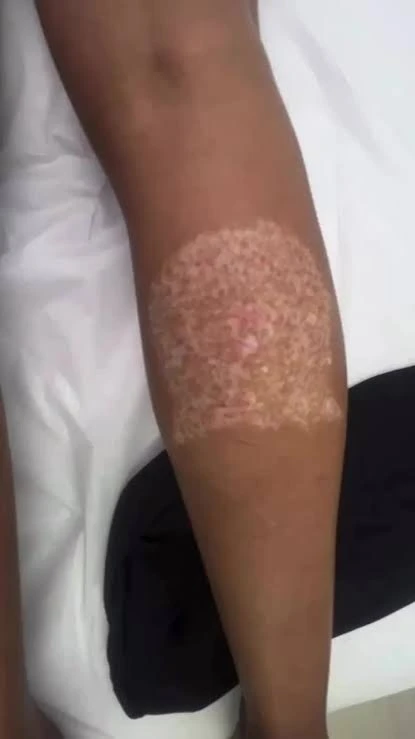
Hypopigmentation on darker skin after laser tattoo removal. The pale patches indicate melanocyte damage from incorrect wavelength or energy settings.
Hyperpigmentation. Darkening of the treated skin, a post-inflammatory response more common in darker skin types. Usually resolves with time but can persist.
Textural changes without color change. A rough, uneven, or slightly raised surface without visible discoloration. Often the pre-existing scar tissue from the tattoo becoming visible, or the result of repeated mild overtreatment.
Normal healing vs. signs of a problem
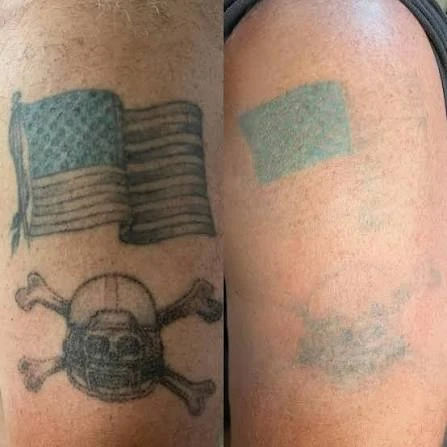
Post session healing after 4 sessions
Normal. Frosting immediately during treatment, then redness and swelling that resolves within 12–72 hours. The skin should look and feel close to baseline within a few days. Tattoos on the lower legs, ankles, and feet typically swell more and may take closer to the upper end of that window to settle. Elevating the area for the first 24–48 hours helps.
Not normal. Scabs still present four weeks after a session. Blistering at every appointment. Skin that looks darker or lighter several weeks later. Open wounds or signs of infection: increasing redness, warmth, pus, or fever. Any of these warrant contacting your provider or a dermatologist.
Most dermatologists have limited knowledge of tattoo removal healing. Go for a skin integrity assessment and infection treatment, not for removal advice.
What to do if you think you're scarring
Stop treatments. Continuing to laser compromised skin adds damage to damage. Wait a minimum of 3–6 months, longer if the skin is still visibly affected.
For hypopigmentation: stop all sessions, apply zinc-based sunscreen every day the skin is exposed, and give your body time. Melanin regeneration takes months. For patients who caught it early, partial or full recovery is common. Severe cases may be permanent.
For textural scarring or keloids: consult a dermatologist. Options vary by type and severity: fractional lasers for textural changes, steroid injections for keloids, silicone sheets for hypertrophic scars. The realistic outcome is improvement, not elimination.
If you had blistering in a previous session, or if you have a history of keloids, tell your next provider before they treat you. This changes both the settings and the protocol.
Before starting with any new provider, document what your skin looks like now. Photos before your next session give you and any new clinic a baseline to work from.
Frequently Asked Questions
Does tattoo removal always scar?
No. Most people complete treatment without permanent laser tattoo removal scars. The risk is real but uncommon when treatments use correct settings, adequate intervals between sessions, and proper aftercare.
Can a consultation predict whether you'll scar?
Not with certainty. A provider can identify risk factors (keloid history, skin type, tattoo density, body location, pre-existing scar tissue) and adjust their protocol. Tattoos with visible texture or raised lines from the application should be flagged before the first session.
Is hypopigmentation permanent?
Often not. Many cases resolve over months when the area is protected from sun exposure. Severe cases from repeated aggressive treatment may not fully reverse. The earlier sessions stop, the better the prognosis.
What separates normal healing from something going wrong?
Normal healing resolves within 72 hours per session. Warning signs: blistering at every session, scabs lasting more than four weeks, and skin that looks worse rather than better between appointments.
Is laser tattoo removal safe for dark skin?
Yes. Tattoo removal on dark skin is safe with the right provider and the right wavelength. The risk for skin types IV–VI is real but protocol-dependent. Treatment at 1064nm, avoiding 532nm, and working with a provider experienced in darker skin types can achieve safe and complete removal.
This article reflects clinical consensus from industry practitioners with 10,000+ treatments and does not rely on a single study or external authority.