To choose a tattoo removal clinic, check who fires the laser, whether that laser can treat your ink colors on your skin, and whether the technician can show their own results on tattoos and skin like yours. Star ratings rarely address those factors, and many can be bought or incentivized.
Every tattoo removal clinic promises the same things: safe, experienced, state-of-the-art technology. And almost every guide on how to choose a tattoo removal provider is written by a provider, describing (promoting) itself.
What matters when choosing a tattoo removal clinic is what clinics often don't advertise. For example, in most states the person firing the laser isn't a doctor, and that's legal. But when we went through the first 2,107 clinic profiles in our directory (there are more now), only 31% named their medical director, the person responsible for making sure you're treated safely.
Pick the wrong clinic and you don't just lose money. You can end up with burns, scars, or pale patches that never get their color back.
I'm not a laser tech. I'm a researcher who has gathered every piece of data I could find on tattoo removal, consulted for clinics, and analyzed over 1,000 case studies for our before-and-after gallery. This guide is what that research says about picking a clinic, without the marketing.
You'll learn who can legally treat you, how to tell if a clinic's laser fits your tattoo, how to read reviews and photos, and what to ask before you pay anything. Let's start with who's even allowed to laser you.
Who Is Allowed to Perform Laser Tattoo Removal?
Who is allowed to perform laser tattoo removal depends on your state. The FDA clears removal lasers "for use by, or under the supervision of, a health care professional." Each state decides what "supervision" means: some require no medical director at all, others a doctor on site for every session.
State rules fall into four groups:
- No medical director required (3 states): Hawaii, Oklahoma and Wisconsin.
- A doctor on site during treatment (13 states): New Jersey, Illinois, Arizona, Ohio, Indiana, South Carolina, New Mexico, Arkansas, Delaware, Louisiana, Alaska, South Dakota and Mississippi require the supervising provider in the building when someone else fires the laser.
- Licensed medical staff only (at least 6 states): California, Florida, Georgia, Connecticut, Montana and New York allow only doctors, physician assistants and nurses. Estheticians and non-medical techs can't.
- Trained technicians under a remote doctor (most other states): in Texas or Pennsylvania, for example, a certified tech can treat you while the medical director supervises by phone.
So a doctor isn't required in most US states, but the laser tech's expertise (how many removals done with one specific laser) is your key decision factor.
A nurse who treats tattoos all day will often beat a doctor who does removal twice a month. Even the AAD says your results "depend almost entirely on the person performing the tattoo removal."
This, however, doesn't mean that medical training is not valuable: the American Academy of Dermatology warns that burns, scarring and texture changes are more common when the person treating you lacks medical training.
There's data behind that. A UCLA study in JAMA Dermatology reviewed 175 laser injury lawsuits from 1999 to 2012, and the share involving non-physicians rose from 36% in 2008 to 78% in 2011. Most were laser hair removal cases, and the data is old, but the pattern holds: risk climbs when untrained people work outside medical settings.
How to Check a Clinic's Medical Director
Ask for the medical director's full name, then look them up on your state medical board's license search. It takes two minutes and shows whether the license is active and whether there are disciplinary actions. A clinic that won't give you a name has answered your question.
We list each clinic's medical director on its profile page whenever the clinic names one.
Which Laser Should a Tattoo Removal Clinic Use?
The right laser is one whose wavelengths match your ink colors. No single laser treats them all, and who uses it matters even more: the most advanced laser is ineffective if the operator doesn't know how to set the right protocols.
So the real question isn't "which laser is best?" It's "which wavelengths does this clinic have, and do they match my tattoo?" We have a full guide explaining how wavelengths target ink if you want to go full nerd mode on this.
Which Lasers Treat Which Colors?
The four lasers you'll meet most often all handle black, but differ a lot on other colors. These are the most-listed lasers in our directory, with wavelengths from our laser database:
| Laser | Type | Wavelengths | Colors they target | Safe skin types (Fitzpatrick) |
|---|---|---|---|---|
| Astanza Duality (219 clinics) | Q-switched (nanosecond) | 1064, 532 nm | Black, dark blue, dark brown (1064); red, orange, yellow (532) | 1064 nm: all. 532 nm: I to III |
| Candela PicoWay (212 clinics) | Picosecond | 1064, 532, 785, 730 nm | Adds green, blue and teal (785/730) | 1064 nm: all. Others: I to III |
| Cynosure PicoSure (69 clinics) | Picosecond | 755, 1064, 532 nm | Strongest on green, blue, purple (755) | 1064 nm: all. Others: I to III |
| Lumenis PiQo4 (37 clinics) | Pico + nano hybrid | 1064, 532, 585, 650 nm | Adds sky blue, purple (585) and green (650) | 1064 nm: all. 585/650 nm: I to II |
If your tattoo is black only, almost any of these will do. If it has green, blue or purple, a laser with only 1064 and 532 nm is the wrong tool, however good the technician is.
How Do You Find Out Which Laser a Clinic Uses?
Ask for the brand and model, not "pico" or "the latest technology." Half the clinics we list never say on their website what laser they use. Trade names hide a lot: "Duality" is an Astanza Q-switched laser, "PicoWay" a Candela picosecond. If the answer is vague, or the clinic mentions IPL (a broad-light device that isn't made for tattoos), look elsewhere. You can also browse clinics in our directory by laser.
Is a Picosecond Laser Always Better Than Q-Switched?
A picosecond laser is not always better than a Q-switched one. Pico lasers fire shorter pulses, which should shatter ink into finer particles. But a 2016 systematic review in Lasers in Medical Science found only "sparse evidence" that they beat nanosecond lasers, and most of the studies had a medium to high risk of bias.
For example, a Pennsylvania clinic owner with over 10,000 treatments, many of them with PicoSure, says it isn't his go-to laser for black ink, because it can't reach the pigment that stays deep in the dermis.
From what we've seen in the 1,000+ case studies we analyzed, a picosecond laser might save you 1 or 2 sessions. That's worth something, but not worth paying double for.
The moral of the story, again: ask every clinic for photos of completed removals on tattoos and skin like yours, not just early fading.
How Much Experience Should a Tattoo Removal Technician Have?
Look for a technician with at least 2 years of tattoo removal under their belt. The clinic's overall experience matters less, because one person should be treating you over the months or years removal takes.
Our totally arbitrary rule of thumb: if a clinic hasn't been open 2 years, or its tech hasn't worked 2 years, take what they tell you at the consultation with a grain of salt. Ten years on the sign and a technician hired last month is a new clinic for your purposes.
Removal takes years, so you're choosing a long relationship, not one appointment. A laser operator who has been through several full removal cycles can adapt their protocols to your situation instead of following a checklist.
Can They Treat Your Skin Tone and Ink Colors?
A clinic can treat your skin tone and ink colors safely only if they have the right protocols and real experience with tattoos like yours. The proof is in their photos. If a clinic shows 200 results and none have bright blue or purple, or none are on skin like yours, ask why before you book.
On darker skin, the main risk is permanent lightening, not just slow progress. Laser light can damage melanin along with the ink, leaving pale patches (hypopigmentation). The 1064 nm wavelength is the safer choice because melanin absorbs less of it. A review in the American Journal of Clinical Dermatology found hypopigmentation far less common with 1064 nm Nd:YAG lasers than with ruby lasers, and temporary lightening in up to 50% of patients treated at 755 nm.
The catch: the colors 1064 nm can't reach (red, green, yellow) need shorter wavelengths, which carry more risk on dark skin. A good clinic will tell you some colors may not be worth treating on your skin. A bad one will promise everything goes. The same applies to scar tissue from the original tattoo: ask to see results on scarred tattoos specifically.
What Can a Clinic Promise About Sessions and Results?
A clinic can give you a session range, but never an exact number, especially before your first session. Anyone who claims to know exactly how many sessions you'll need before seeing how your skin reacts is guessing, or selling. After the first session they can make a more educated guess, but it's still a guess.
A good clinic also defines what "complete removal" means on day one. Many clinics count 90 to 95% fading as removed, so faint traces may stay. Setting that expectation at the first consultation beats apologizing for it in year three.
No one can guarantee 100% removal. The FDA says complete removal "can take many treatments, and in some cases may not be possible." If a clinic promises it anyway, ask what happens when they call you "clinically removed" and you can still see flecks of ink.
What Does a Good Tattoo Removal Consultation Look Like?
A good consultation looks at your skin and ink first and talks about price last. It covers your medical history, the risks for your skin and a realistic plan. Then it lets you leave and think.
Avoid at all costs tattoo removal services that don't give you time to think. Patients tell us this again and again. Many clinics book consultations in 15 or 20 minute slots, so the talk ends with a rushed "we can start today." The treatment itself takes 30 seconds to a few minutes. The decision shouldn't be squeezed into whatever time is left on the clock. Red flag.
You also need to like the person who treats you. You'll see them every 2 or 3 months for years. If you don't feel comfortable asking a question or raising a concern, keep looking.
Lastly, even if your consultation was satisfactory, book more with other clinics. They are mostly free anyway. In our directory, 93% of clinics don't charge for one. Many will also give a rough estimate by email from photos and measurements, which can save you a trip to clinics that are out of your budget.
What Should a Tattoo Removal Clinic Tell You About Price?
You should get three things in writing before your first session:
- The cost per session (or the total for a package) for your tattoo's size.
- What that price includes.
- What happens to your money if you stop.
A clinic that can't answer all three isn't ready to take your money.
The total matters more than the price per session. The number of sessions drives your bill far more than the rate, so a cheap clinic that needs 4 extra sessions often costs more in the end. Our guide on why the cheapest clinic often costs more does the math, and you can estimate your total cost before calling anyone.
A transparent clinic publishes its prices per session by size. Only 60% of clinics in our directory publish even a starting price. Size tiers (for example, "extra small" for a 1" x 1" tattoo) let you check a quote against the list, but don't be surprised if your final quote comes in higher than you expected.
Ask what the price covers, because clinics bundle differently. One includes numbing, cooling and aftercare supplies in the session price. The next adds them on, or charges for a patch test. Also ask whether the price changes if they switch lasers partway through. Some clinics charge one flat rate whatever laser they use.
Read the refund policy before you buy a package. About half the clinics in our directory sell packages. Of the clinics whose refund terms we could collect, not one refunds unused sessions if you change your mind. LaserAway's published terms, for example, call every sale final, unused sessions included, and pay the rare exception in store credit. Removery refunds only if its medical director decides you can't safely continue, at the discounted package rate, minus a fee of up to $100. A package is a bet that you'll need every session in it, so ask what one session costs on its own.
Last but not least, never let the clinic finance the full amount upfront through a loan it arranges. These loans often carry high interest, and the loan doesn't end if the clinic does. When the Dr. Tattoff chain closed clinics across several states in 2017, patients who had prepaid packages lost their money, and anyone who had financed one still owed the lender.
For pricing models and the fine print in a quote, see our guide on how to read a tattoo removal quote.
What Hygiene Standards Tattoo Removal Clinics Should Follow
A tattoo removal clinic should follow medical-grade hygiene: washed hands and fresh gloves at every session, skin and equipment disinfected between patients, laser goggles for everyone in the room matched to each wavelength, and a written health check before the first treatment. Treat any salon-style shortcut as a warning. You can check most of this from the clinic's photos and videos before you book.
Cleaning. The technician should wash their hands before putting on gloves, clean your skin before treatment, and wipe the chair, handpiece and cooling nozzle with a hospital-grade disinfectant between patients. Many clinics also cover the handpiece and controls with a disposable plastic barrier. Ask which parts are single-use. A tidy room proves little, but a messy one tells you how much care goes into the parts you can't see.
Gloves. Gloves are standard at every session. The laser can cause pinpoint bleeding, and blistered skin is an open wound. A clinic should stock nitrile gloves as well as latex, for patients with a latex allergy. Two easy red flags: staff working without gloves, and patients wearing jewelry during treatment. Jewelry is a hygiene problem, and metal can reflect laser light toward the eyes.
Eye protection. Everyone in the room should wear laser goggles, you included. The US laser safety standard for health care, ANSI Z136.3, calls for eye protection matched to the laser's wavelength. A clinic with several wavelengths needs goggles for each one. Sunglasses don't count.
Health check. Expect one before your first session. A good clinic asks about your medications, skin conditions, past scarring and recent sun exposure, and writes it down. The answers change the laser settings, and sometimes whether you should be treated at all.
Smoke evacuation. There should be a smoke evacuator next to the laser. Each pulse releases a plume of ink and skin particles, and a good clinic pulls it away from your face and the technician's.
Warning sign. There should be a laser warning sign on the treatment room door. It's required in most medical settings and easy to spot in clinic photos.
What to Look for in a Clinic's Photos and Videos
Scroll through the clinic's website, Instagram and TikTok before you book. Treatment photos and videos show most of what matters:
- Gloves on the technician. Bare hands on a laser handpiece are a red flag.
- No jewelry on patients. Rings, bracelets and watches near the treatment area are a hygiene risk and can reflect laser light.
- Goggles on everyone. The patient, the technician and anyone else in the room should wear laser goggles, not sunglasses.
- A smoke evacuator next to the laser. It looks like a small machine with a hose aimed at the treatment area.
- A laser warning sign on the door. Easy to spot in photos of the treatment room or clinic entrance.
- A barrier on the handpiece. A clear plastic cover on the handpiece or controls means it's changed between patients.
- A clean, uncluttered room. It doesn't prove the equipment is sterile, but clutter suggests less care elsewhere.
- A sterile dressing after treatment. Aftercare shots should show the treated area covered, not left open.
One missing item in a single photo isn't a dealbreaker. The same gap across several posts is.
What Aftercare Should a Tattoo Removal Clinic Give You?
A tattoo removal clinic should give you written aftercare instructions, explain what normal healing looks like, check your skin before every session, and stay reachable in between. How you heal decides your scarring risk and when your next session can happen.
Your instructions should come from your clinic, not the internet. The clinic knows your laser settings and your history. A forum doesn't, and neither do we. That said, here's what good written aftercare should cover:
- Dressing. After each treatment, the clinic should apply a sterile non-stick dressing and tell you when you can take it off. Be careful with sealed film dressings like Tegaderm unless your clinic recommends them: they can trap heat and sweat, raising the risk of blisters and infection.
- Washing. When you can first wash the area, usually after 24 hours, with lukewarm water and a mild fragrance-free soap. Pat dry, don't rub.
- Ointment. What to apply, how often and for how long. A thin layer of petroleum jelly or a healing ointment is common.
- Blisters and scabs. Hands off. Popping or picking them invites infection and scarring.
- Itching. What's safe to use. Scratching does the same damage as picking.
- Water and heat. No baths, hot tubs, saunas or swimming until the skin has closed, usually 1 to 2 weeks.
- Exercise and clothing. Avoid heavy sweating for a few days, and wear loose clothing that doesn't rub the area.
- Sun. Keep the area covered while it heals, and use SPF 30 or higher on healed skin for your whole course of treatment.
What Normal Healing Looks Like
- First hours: the skin turns white (frosting) for a few minutes, then red and swollen.
- Days 1 to 3: blisters often appear. They're normal and usually settle within a week.
- Weeks 1 to 2: scabs form and fall off on their own. The surface is usually closed by the end of week 2.
- Weeks 6 to 8: the skin underneath has recovered and your body has cleared more ink. This is why sessions are spaced weeks apart.
Ask who you can call when something looks wrong. Blisters, swelling and redness are normal, but the AAD says to contact your provider at signs of infection, like spreading redness, increasing pain, pus or a fever. A clinic that says "see you in 8 weeks" and nothing else leaves you guessing.
A good clinic checks your healing before every session. If your skin hasn't healed, they wait. If pale patches appear (hypopigmentation, where the skin loses its natural color), many practitioners pause treatment for at least 6 months, keep the area out of the sun and reassess. A clinic that lasers unhealed or depigmented skin to keep the calendar full has its priorities backwards.
What Do Tattoo Removal Reviews and Photos Actually Tell You?
Star ratings tell you little about a tattoo removal clinic, because almost every clinic scores high. The review text tells you more: which technician patients trust, how many sessions their tattoos took, whether anyone scarred, how the clinic handles complaints, and which reviews may be fake.
Ratings barely separate clinics. Across the 244K reviews in our directory, the median rating is 4.9. A 4.9 tells you a clinic probably isn't bad. It doesn't tell you it's good.
Open a clinic on Google Maps and read the reviews for these signals:
- Technician names. Patients who name their technician unprompted, with specific details about their treatment, are a good sign. Be careful when nearly every review names the same person in similar words. Since April 2026, Google has banned businesses from asking for reviews that name staff, so a wall of name drops can mean the reviews were coached. Either way, ask whether the technician patients praise is the one who'll treat you.
- Session counts. "Gone after 8 sessions" tells you more than "amazing results." Compare it with what the clinic quoted you.
- Reviewer photos. Before-and-after photos posted by patients are harder to stage than the clinic's own.
- Side effects. Look for mentions of scarring, lightened skin or blisters that wouldn't heal, and how the clinic responded.
- Owner replies. A calm, specific reply to a bad review is a good sign. A defensive reply, or none at all, is not.
How to Spot Manipulated Reviews
Google doesn't allow reviews from people with a conflict of interest, like owners, staff or their friends, and in the US the FTC bans fake reviews. It still happens, and it's rampant. Red flags:
- A perfect 5.0 with a lot of reviews. I help brands with their Google presence, so trust me: a perfect score is more often than not too good to be true.
- Glowing or angry reviews from accounts with only 1 or 2 reviews.
- A burst of 5-star reviews in a few days, especially right after a bad one.
- Several very long reviews, or reviews with similar wording.
- The same staff member named in most reviews, in similar words.
- A discount or free session in exchange for a review, sometimes offered before treatment even starts. It doesn't mean the clinic is bad at removing tattoos, but it's ethically questionable.
How Can You Tell If Before-and-After Photos Are Real?
Real before-and-after photos show the clinic's own work, on healed skin, with a session count. Look for "photo courtesy of..." in the corner or under the image. That credit means the photo came from the laser manufacturer, taken at another clinic by another tech. A clinic with no photos of its own work isn't a great sign.
A few more checks:
- Healed results, not same-day photos. Skin turns white right after a session (a reaction called frosting), which makes the tattoo look lighter than it is.
- A session count on every photo. "After treatment" without a number tells you nothing.
- Tattoos like yours: same colors, similar size, similar skin tone.
- The technician's own Instagram. Many good techs post their work. Look for full removals, not session-two fading.
Only 62% of clinics in our directory have before-and-after photos on their website. Don't cross the rest off yet: see what realistic progress looks like in our 1,000+ real before-and-after cases, filtered by the laser the clinic uses.
Which Is Better for Tattoo Removal: a Specialist, Chain, Medspa or Dermatologist?
For most tattoos, a dedicated, independent tattoo removal clinic is the best fit, because removal is all they do. Choose a dermatologist if you've had keloids, scarring, a skin condition or complications with another provider. Medspas and tattoo shops can work too, but check the operator's laser experience carefully.
- Independent specialists. They usually have the most hands-on experience with tattoos like yours. Quality depends on the owner and the technician. Best for: most tattoos, if you check the clinic's reviews, photos and hygiene first.
- Chains. Also removal-only, with consistent lasers and protocols across locations and large before-and-after galleries. Expect a strong push toward prepaid packages. Best for: people who want predictable pricing and a long track record.
- Medspas. Removal is one service among many. Expect upsells like hair removal and injectables, and prices that carry a bigger business's overhead. Supervision and laser experience vary widely. Best for: a medspa you already trust, with a technician who does removal every week.
- Tattoo shops. Convenient, and some offer fading before a cover-up. Who may operate a laser depends on your state, so check the rules and the operator's training. Best for: lightening a tattoo you plan to cover.
- Dermatologists. The most medical training and usually the highest price. Best for: keloids, scarring, skin conditions, ink allergies, or complications from earlier treatment.
| Provider | Who usually treats you | Removal focus | Median price per session* | Best for |
|---|---|---|---|---|
| Independent specialist | Laser technician or nurse | Removal only | $99 to $450 | Most tattoos |
| Chain | Laser technician or nurse | Removal only | $200 to $420 | Predictable package pricing |
| Medspa | Nurse or technician, physician-supervised | One service of many | $100 to $500 | A medspa you already trust |
| Tattoo shop | Laser operator | Often fading for cover-ups | $100 to $313 | Lightening before a cover-up |
| Dermatologist | Physician or physician-supervised staff | One service of many | $200 to $825 | Medical risk factors |
*Median lowest and highest price per session, from 772 clinics in our directory with published prices.
What Questions Should You Ask a Tattoo Removal Clinic?
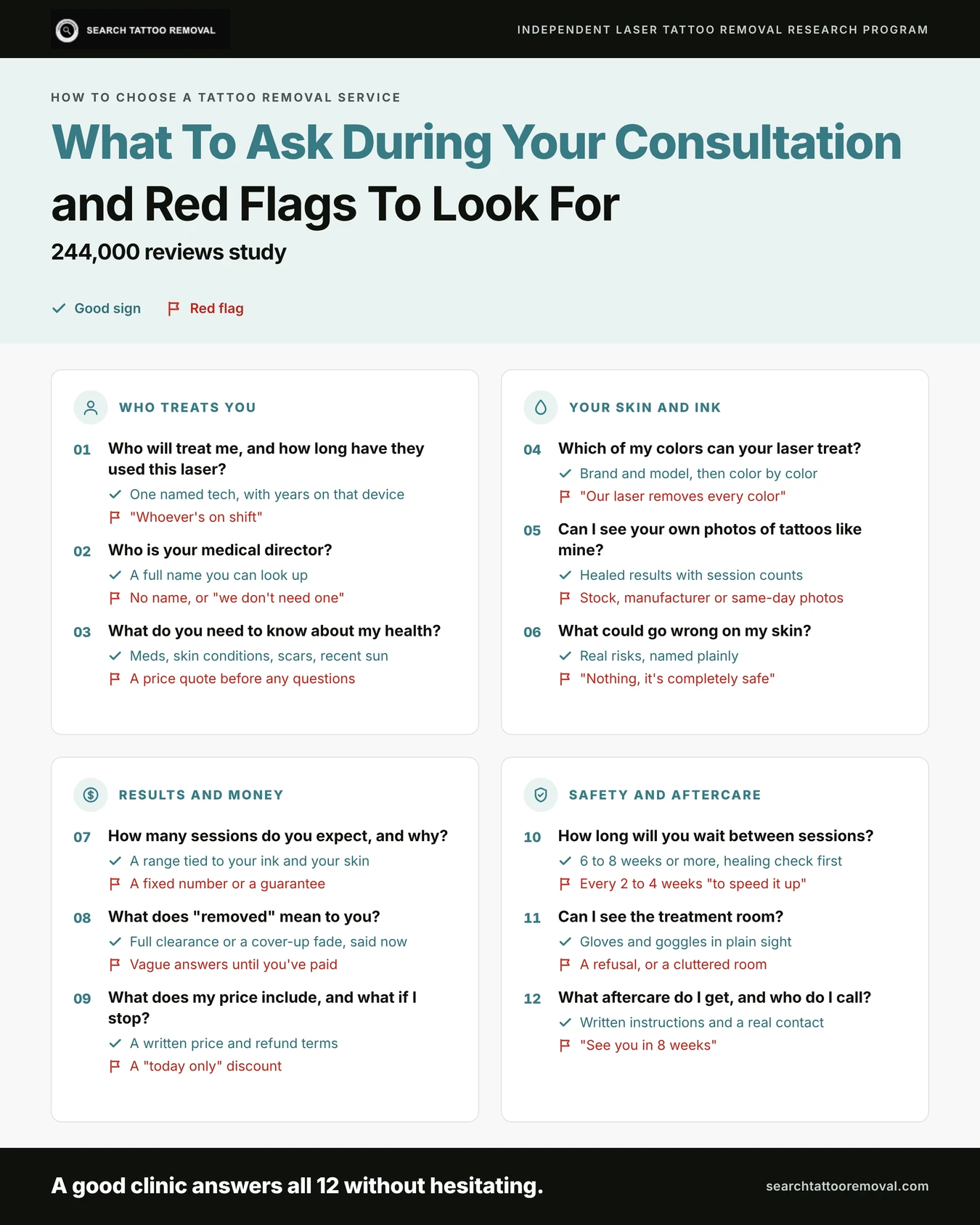
Ask every tattoo removal clinic who will treat you, which of your colors their laser can treat, how many sessions they expect, what could go wrong, and what the price includes. Ask each clinic the same questions so you can compare answers side by side. Start your shortlist by searching clinics near you by laser and price, then book 2 or 3 consultations and bring this checklist.
- "Who will treat me, and how long has he/she used this laser? Can I see result photos?"
- Good sign: a named person, the same one every visit, with years on that device
- Red flag: "Whoever's on shift," or a different person each time
- "Who is your medical director?"
- Good sign: a full name you can look up, if your state requires one
- Red flag: no name, or "we don't need one" where the rules say they do
- "What do you need to know about my health?"
- Good sign: questions about your medications, skin conditions, past scarring and recent sun exposure
- Red flag: no questions before they quote you a session
- "Which of my colors can your laser treat?"
- Good sign: a brand and model, then color by color, honest about the stubborn ones
- Red flag: "Our laser removes every color"
- "Can I see your own photos of tattoos like mine?"
- Good sign: healed results with session counts
- Red flag: stock or manufacturer photos, or only shots taken right after treatment
- "What could go wrong on my skin?"
- Good sign: real risks named: lighter or darker patches, texture changes, keloid scars, hair loss, ingrown hairs
- Red flag: "Nothing, it's completely safe"
- "How many sessions do you expect, and why?"
- Good sign: a range tied to your tattoo's colors, ink density and your skin
- Red flag: a fixed number or a guarantee before they've examined the tattoo
- "What does 'removed' mean to you?"
- Good sign: a clear answer now on whether full clearance or fading for a cover-up is realistic
- Red flag: vague answers until you've paid for several sessions
- "How long will I have to wait between sessions?"
- Good sign: 8 - 12 weeks or more, with a healing check before each one
- Red flag: sessions every 2 to 4 weeks "to speed things up"
- "What does my price include, and what happens if I stop, or if I need more sessions?"
- Good sign: a written price for your size, a list of what's included, and refund terms you can read before paying
- Red flag: a "today only" discount or no refund terms in writing
- "Can I see the treatment room?"
- Good sign: gloves and goggles in plain sight, equipment wiped down between patients
- Red flag: a refusal, or a cluttered room
- "What aftercare will you give me, and how do I reach you between sessions?"
- Good sign: written instructions for your treatment, and a number or message line someone answers
- Red flag: verbal instructions only, or "see you in 8 weeks"
For the rest of the pricing questions, use the full list in our quote guide.
When Should You Switch Tattoo Removal Clinics?
You should switch tattoo removal clinics after a burn or scar they brush off, no visible fading after 3 or 4 sessions with no change of plan, or being told to come back after only a month. You can switch at any point, and you don't owe the clinic an explanation.
Monthly visits are the clearest red flag of all. Your body keeps clearing ink for months after each session. Coming back every 4 weeks doesn't speed that up. It just gives your skin less time to heal. A clinic that pushes monthly visits is selling sessions, not results.
Ask for your records before you go: dates, the laser and the settings used. A new clinic can pick up from there instead of starting blind.
Conclusion
The best tattoo removal clinic isn't the one with the highest rating or the newest laser. It's the one that shows you everything.
- Disclosure is the filter. A clinic that names its laser, its medical director, its prices and its own results has nothing to hide.
- Your state sets the floor, not the standard. Check the law, then check the person who will actually treat you.
- Proof beats promises. Healed photos of tattoos like yours are worth more than any guarantee.
Start by searching clinics near you. Every profile shows the clinic's laser, your state's rules and its photos where it has them. Shortlist 2 or 3, book the free consultations, and bring the checklist. A week spent choosing well is nothing next to years with the wrong clinic.
Frequently Asked Questions
Is it worth traveling farther for a better tattoo removal clinic?
Traveling farther for a better tattoo removal clinic is usually worth it, because you only go every 8 to 12 weeks. That's about 4 to 6 trips a year. Small towns may have one option, and an extra hour on the road a few times a year costs far less than fixing a burn or paying for wasted sessions.
Should a tattoo removal clinic do a patch test first?
A tattoo removal clinic should offer a patch test, a small test spot before treating the whole tattoo, if you have darker skin, a history of scarring, or colors that can darken. It shows how your skin and ink react at the planned settings. Many clinics, Removery among them, include one in the first visit.
Does a free tattoo removal consultation commit you to anything?
A free tattoo removal consultation doesn't commit you to anything. You can take the quote home, compare it, and never go back. If a clinic asks for a deposit, a signature or a card on file before you've decided, treat it as a sales tactic. Our quote guide covers what to check before signing.
What should you do if a tattoo removal clinic burned or scarred you?
If a tattoo removal clinic burned or scarred you, see a doctor first, then file a complaint with your state medical board. Take photos and keep your session records. If the laser itself seemed faulty, report it to the FDA's MedWatch program. Don't go back to the same clinic for more treatment.
Do you need a doctor's referral for laser tattoo removal?
You don't need a doctor's referral for laser tattoo removal, but some states require a medical exam before your first session. In Tennessee, a doctor, nurse practitioner or PA must approve treatment first. Utah requires an in-person evaluation, and Illinois requires the physician to examine every patient.
Can a tattoo shop legally do laser tattoo removal?
A tattoo shop can legally do laser tattoo removal only where state law lets a non-medical business run a medical laser. In California, removal must happen inside a physician-owned medical practice, so a regular tattoo shop can't offer it. In Mississippi, the state medical board treats any cosmetic laser use as the practice of medicine, so a doctor must be on the premises for every treatment. Check your state's rules in our directory before booking with a shop.